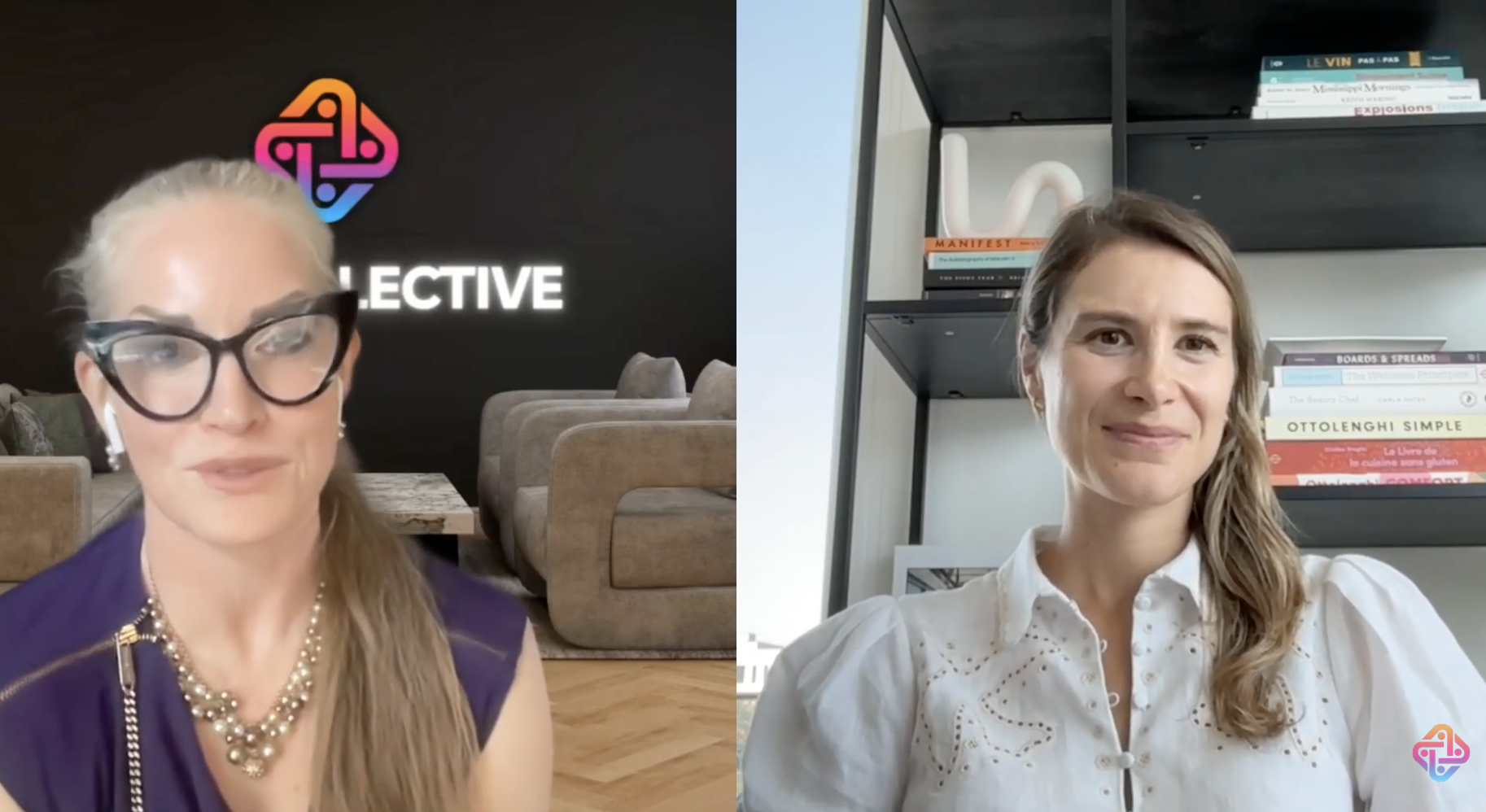
I was asked ten questions on a podcast. Here are the most insightful things I distilled for anyone and everyone wanting to feel healthy, learn about the industry or take a step into entrepreneurship.
(For the full article go to my SUBSTACK)
I was asked ten questions on a podcast. Here are the most insightful things I distilled for anyone and everyone wanting to feel healthy, learn about the industry or take a step into entrepreneurship.
Longevity and wellness are exploding, I share what I see as the biggest opportunity for consumers, brands and people interested in healing themselves, and building in this industry.
List here:
1. Connect the dots for me. Take me back. How did you get from impact finance in Africa to the frontier of longevity?
Well what I can start with was it was definitely not a straight line.I spent five years in impact finance, designing and scaling structured debt products for some of Africa’s fastest growing technology companies. I was travelling constantly, building partnerships with venture capital firms across Ghana, Nigeria, Kenya, Mauritius and Mexico, overseeing a portfolio of companies that were changing how people in emerging markets accessed financial services. It was purposeful work and I loved it deeply. This was actually where I learnt the power of ecosystems and why I became obsessed with an ecosystem for any business. When I started with our finech team we actually had zero investment dollars for fintech, our company was mainly focused on investing in energy, agri, microfinance, renewable projects, leasing and some technology. We saw the power of fintech in emerging markets as enablers and having outsize impacts so we decided to use our connections to understand the size of the market. Our small team, at that time three people reached out to all our contacts, which were VC firms, incubators, acclerators, private investors, corporates and beyond to understand the size and scope and where investment was going. That’s how I started building our own ecosystem for the fintech team. Fast forward nearly two years we grew our portfolio to $200 million because we were able to leverage our ecosystem and partnerships to be in the right deals, in the right co-investments and understand the markets we were in exceptionally well.
But somewhere in the middle of all of that I kept noticing a pattern amongst entrepreneurs. The founders I was working with at this debt investment company, the ones I was advising and angel investing in on the side, the moment their health took a hit, their business followed. They would push through when they needed to rest, they would ignore the signals their body was sending, and the downstream effects would show up in their decision making, their leadership, their capacity to build. I kept seeing it over and over and it started to feel like the most important thing nobody was talking about.
So I began thinking about what it would look like to build something that actually addressed that. I became an advisor, and a coach for founders and high-performers so that I could support entrepreneurs on a deeper level. It also helped me understand the problem more profoundly. I learned that self-awareness is probably the most powerful tool we all have to cultivate to achieve our dreams. Then I learned that the physical foundation, the biological infrastructure that everything else runs on is intricately connected to our mindset and our abilities. That thinking eventually led me to longevity, and from longevity to launching Powercube in Geneva as founding COO, of a 360 degree performance and longevity club built on exactly that premise. The dots only connect looking backwards but when I look back now it all makes complete sense because the foundation of a healthy and sustainable business is a healthy and sustainable person.
2. You have a line I love: longevity is the ultimate compounding strategy that you mention on your website and you speak about often. Unpack that for me.
In finance everyone understands compounding returns. The snowball effect where every gain is reflected in the principal, which increases the impact of every subsequent gain. The longer the runway, the more powerful the compounding becomes. That is why starting early matters so much, not because of the initial return but because of what that return generates over time.
I thought about that and realized the exact same principle applies to personal health and longevity in business. If I can extend my healthspan, my peakspan, the period in which I am performing at my highest potential, then every year of that extended capacity compounds into better outcomes. More ideas brought to life, more impact created, more relationships built, more value generated. The longer I can maintain my physical and cognitive performance, the more my life’s work actually compounds.
And the same is true in business. If you or your business are only thinking short term, positioning reactively to markets and clients and trends, you are never going to benefit from the compounding effect because your strategy is constantly shifting. There is no long term horizon guiding the vision. Longevity thinking in business means making decisions today that your future self will benefit from exponentially, not just decisions that solve the immediate problem. That is the compounding strategy. And it applies to your body, your business and everything in between.
So ask yourself for any decision you are making today, are you doing this for short term gains or is this going to generate value for years to come, and does it align with your long-term vision? As long as your honest with these questions then the self awareness around how you move will allow you to go further with ease.
3. You bring a finance lens to a wellness world. What does capital see in longevity right now, and where is the money actually flowing?
Not only do I bring the finance lens but since my time working in emerging markets I bring the lens of how can we take our resources as far as possible. Even though we are not resource scarce in the Western world, the more a founder or business can think in a resource savvy way, the better off the company will be long term. Valuations for a company do not mean you are profitable or succesful, the most efficient way to grow is through profitable margins right off the bat. Raising capital should be done only if a business needs this rather than just to prove that they can raise money, because I have seen founders raise money and then have no idea what to do with it and have it sit around in the bank. This is a completely inefficient use of capital. Find others solutions, factoring for inventory based businesses, bank loans, revenue-based financing, for wellness businesses now their are even companies like Bonside in the US that that help finance brick and mortar spaces with no equitty because wellness brick and mortar has grown at such a fast pace. Don’t run for equity just because everyone else is doing it, think sustainably about what the cost around that is for you, your business and your future.
In terms of where capital is flowing, there are more longevity and wellness investors now than there were five years ago (obviously!). But the difference is, most of what we saw then were investors backing biotech companies, focusing on very specific IP and deep science. Companies like Juvenescence, Insilico. A combination of deep science, technology and AI researching specific topics or focusing on specific results in let’s say Alzheimers or Cancer research or a specific ingredient around a longevity biomarker.
What we see more of now are investors are investing in the longevity products, services and ecosystems that are science-backed, data driven and closer to the consumer. Bringing the science down to the masses. Some of the trending categories I am seeing are diagnostics and specific service based brands built around one specific topic. Liver health, for example, or spaces giving people access to take their health back into their own hands. The Liver Clinic, Function Health, Neko Health, Parsley Health. These are companies that bring the science to the consumer and support people on their journey of preventative health. Preventative health solutions is what society has been actively moving toward because we realized that our current medical system functions only as a sick care system not on a system that is meant to optimize our health and functioning.
I also work with science-backed longevity skincare brands as well as wellness clinics and what I notice is, we are seeing a reinvention of skincare that is using longevity science at its core, whether that is working at the dermal fat cell level or on the mitochondrial layer. Brands are going deep into the science, running clinical studies, running cohort studies and showing the evidence behind the brand. One company I work with, Adipeau, has unpacked that skin volume loss is actually a byproduct of dermal fat cells getting larger rather than shrinking. The two products they created, a volume cream and a strength gel, work directly at that level to bring back volume. That is longevity science applied to skincare in a way that actually means something.
And then there is women’s health, which is finally getting the support it deserves even though my focus has been on this for years. The hormonal life cycle, perimenopause, postpartum and beyond. Women are finally taking control and capital is starting to follow.
Of course, we would be amiss not to mention the huge peptide industry that is exploding right now (listen to our views on what’s happening in that industry on the podcast here).
And those are just to name a few…
4. You built Powercube from concept to reality, a 360 performance and longevity club. What did that teach you about what good looks like in this space?
Well first of all let me start with, Powercube became my officially unofficial PIVOT into wellness and longevity, I had been adivsing and active in this industry probably for over a decade. Acting as a supporter to businesses in this field, having been a fitness instructor myself in my youth I always had my hand in the wellness world. Also having lived in California, I did become a bit of a wellness junkie and inspired by their obsession on taking care of themselves. Did I ever feel I was fully ready ot take on this world - well for 10 years I did not. Powercube was my FULL official pivot into launching something of my own (alongside two founders) and moving fully into wellness and longevity and it allowed me to use all the skills I had learned across industries like technology, finance, roles in partnerships, investor relations, and beyond to really hone in everything at scale into a physical consumer business. This is no easy feat.
So what did building in this space teach me? Well, it taught me that the vision is almost alwasy the easy part. Then its believing in yourself and further, the execution which is where you find out what you are actually made of and also what your partners and team are made of. You can only learn this under pressure.
I also learned about what good looks like in the physical business of longevity and it is this: integration is everything. The best longevity spaces are not a collection of services sitting next to each other. They are a coherent ecosystem where every element supports every other element. At Powercube, we were a 360 performance and longevity club, bringing preventative health to clients in Geneva from a non-clinical lens.
We provided diagnostics using Technogym’s state of the art technology and our wearable partnership with Ultrahuman. This and personalized consultations informed a clients personal protocol both in the fitness and in the biohacking space. Personalized protocols were based on a clients actual goals and contraints and real conversations with experts. Protocols also informed nutrition. Our built in Fuel bar at Powercube provided nutritious information for the cells from the food in our longevity-nutritionist designed meals. Instead of cooking this in-house, I decided we should partner with a local cafe that sources the best products, mostly local and focuses specifically on quality. Partnering with the right people also showed us where our power is. Every element of Powercube was thought through and faced many changes and pivots, from the vision to offer, to partnerships to design. And the community ties all of it together in a way that keeps people coming back not just because the services are good but because they feel seen and cared for, and they see results.
The other thing as an entrepreneur I learned which is much more obvious in practice is that you need to think for long-term, a few years ahead not just for the next goal or the short term revenues. I think there were moments where we could have done that better.
Powercube was an amazing journey for me, having been the founding COO and building our vision from scratch and really building out the operations, pulling in the right partners to create something outstanding and never seen before in Switzerland is something I am incredibly proud of. Nevertheless, once I saw the success ramping up I felt inside that there was more for me, and consulting and advisory for the founders and companies I always loved supporting felt like it had to be my top priority again.
Some people ask me why? For one, I learned so much I had to tell all the founders I worked with on how to improve, optimize, and succeed as an entrepreneur in the wellness and longevity space. Because now I had the missing piece, which was the entrepreneurs experience, and the operator lens which until now I had never experienced before. Inegrating my experience into my advisory and mentorship practice felt like a no-brainer. I also missed having a global impact and wanted that connection back to the global wellness and longevity world. Being constantly self-aware about myself, my needs and my dreams, and listening to my intuition allows me to know when something is calling me and when I am ready to move on to something new. That’s how my life has been guided up until this point.
There were so many lessons in this experience and it was 2 years of amazing work, hard moments, deep success, tears and long nights and it was so worth it. (Definitely another article on this journey and how I got there coming soon to my substack).
5. Let us talk emerging trends. What is new and exciting in longevity right now and what is just noise?
The peptide industry is obviously booming. This is not new but it is happening rapidly and across the globe. Everyone I speak to in the industry is actively trying to bring regulated or high quality peptides into their services. The US just approved six peptides but even before those were approved there were brands sending peptides directly to your home, so regulation has had to catch up because the demand has been so high.
Then there is the GLP-1 support infrastructure which is going to need to grow significantly. GLP-1s trigger rapid weight loss which means rapid muscle loss, skin volume loss, and a real identity shift around body image. More companies will need to serve the client around the GLP-1 journey. Nutrition knowledge specific to those users, strength training protocols, skincare and body care brands that work with the physical changes happening to these bodies. Rapid fat loss causes significant skin changes that are largely not reversible. So adjacent brands will need to build real ecosystems of support around these clients.
I am also seeing neurotech becoming a significant category. Focusing on performance but also on rewiring the brain through different protocols, programs and products. Diagnosing actual brain activity, working on focus, memory, calm. Our brains have been permanently altered with our use of smartphones and technology, we are actively trying to find a way to improve that. Then products like medical grade red light therapy helmets are actually working to reduce cognitive decline. It is early days for some of this technology but it is real and it is moving fast.
I also love the soulful, spiritual perspective towards wellness, and I think although thats not specifically related to longevity science, I do see that people are looking for more solutions for a holistic whole body approach. We now understand more and more that there is substance to us beyond that of just our body and our brain, that there are deeper questions, around connection, consciousness, and layers that we need to support in our spiritual and energetic development that also support our long term health and vitality and more physical spaces are starting to approach that. Hopefully products follow along as well.
What is just noise? Anything that cannot explain the mechanism behind why it works. Anything that leads with the aesthetic rather than the outcome. Anything that has not been tested on real people and is just riding the longevity and wellness wave because the category is hot. Consumers are becoming more discerning and the brands that cannot show the science or results are going to feel that shift very quickly.
6. Where are the biggest opportunities you are seeing for founders and operators?
The biggest opportunity right now is to build companies that bring science down to people in a way that creates a measurable, long term improvement in health and wellness. Not just products that sound good or look good on a shelf but companies that are backed by trust, that solve a real and validated problem and that can show the evidence.
Beyond that, companies that are creating real community and real connection with their clients in person are going to go further for longer. The online world gives you reach but it does not give you the depth of relationship that keeps a client for life. The brands that figure out how to do both are the ones I am most excited for.
And then there is the infrastructure for partnership which I think is finally ready to be scaled. More brands should be looking at how they can partner with adjacent businesses, whether that is creating combined offerings or collaborating to build communities together. Our peers are ACTUALLY our peers not our competition, if more brands thought like this they would scale faster, go further and get so many of their most pressing questions answered in the early stages of their business. For later stage companies, partnerships and a robust ecosystem allows for companies to scale new products, build out new client communities and open up new markets. The longevity industry is mature enough now that the ecosystem thinking which has always been necessary is finally becoming possible to execute at scale.
7. Partnerships and ecosystem are central to how you work. Why do so many good products fail without them and what does a strong ecosystem look like?
Partnership and ecosystem are core to any business’ survival and ability to thrive. I actually wrote my master’s thesis on entrepreneurship ecosystems specifically in Africa and I always come back to Isenberg’s model and the six domains required for businesses to thrive: conducive culture, enabling policies and leadership, human capital, venture friendly markets, and a range of institutional supports. This concept of the ecosystem also works on the micro level of the company. An organization requires a conducive local culture within its environment, enabling regulations or social acceptance around the product (think peptides), human capital and expertise in the field so you can build an A-team, capital that is ready to finance your ideas, and adjacent business or industries that are supporting your business’ growth.
Most companies do not realize they are already functioning within an ecosystem. You have your staff, your clients, your suppliers, your stakeholders, your partners, your regulators. Each one plays a role in how your business functions. But most companies build these relationships as a secondary thought, a byproduct of what they are actually trying to do. If business leaders thought about ecosystem from the earliest possible days, the company would function more efficiently, more sustainably and be far more ready for the long term. Ecosystems build in long term thinking because signals come from partners about where markets are going, how clients are reacting, what is shifting before it shows up in your own data.
A company can use partners to validate their product, support them scaling, create community, build trust and visibility, save on costs, serve varying client profiles. It is one of the most underutilized strategic tools available to any founder.
The hospitality industry does this particularly well right now. The Carillon in Miami has over 30 different longevity tech companies integrated into their offering, all scaled through partnerships. Le Crans in Switzerland has built their longevity offering through partnerships combining eastern medicine, nature, nutrition and InoHealth Vitality programs. SHA Wellness Clinic empowers their staff to find the absolute best partners in each specific domain and bring them in, they even have a partnership with WHOOP to support the data layer for the clients entering their programs. That approach around collaboration allows companies to build knowledge, share resources and scale together in a way that no single company could do alone.
(For the full article go to my SUBSTACK)
